



One claim I’ve heard a lot over the past couple of years is that cold emailing isn’t effective anymore. People often blame this on “AI slop,” but I don’t think this is necessarily the case. When cold emailing “doesn’t work,” I believe it’s because freelancers often go into it without the right strategy. For instance, they’re either targeting the wrong companies, unsure how to find the right contact person, or don’t know how or when to follow up.
I’ve been using cold outreach as part of my client acquisition strategy for years, so for me, there’s not a lot of guesswork anymore. So if you’re wondering if cold emailing can work for you but aren’t sure where to start, feel free to borrow my five-step process.
1. Pick an industry you want to target and be specific
Honestly, this is probably the most important step because if you pick the wrong kind of companies, you’re not going to get the results you want. You want to email potential clients who need freelancers and have a large budget to pay them. This can take some trial and error to figure out, but here are the primary things I pay attention to.
Company size
I prefer to work with companies that earn $50 million or more in annual revenue. My experience is that big companies have established processes for working with freelancers, which I appreciate. They also tend to pay better, and are just more likely to pay you in general since they’re well-established.
However, there are downsides, especially if you’re writing for really big, well-known companies. They can have very extensive (and sometimes tedious) onboarding processes, and some have Net 45 payment terms, or longer.
That doesn’t mean you can’t write for smaller companies. I’m just sharing my preference, and I realize it’s not for everyone. Every company type has its own set of trade-offs, and it really comes down to your personal preference.
Tip: Use Growjo to find a company’s revenue — it’s really easy to use and free. You just search by the company’s name, and you’ll see the revenue, valuation, and how many employees they have.
In-demand industries
Start paying attention to which industries are growing and might have a need for freelance writers like you. You can discover this by monitoring job boards, like LinkedIn or ProBlogger, or using a tool like Google Trends. You can also learn a lot about what’s working and what isn’t by talking to other freelance writers. I do this with a mastermind I’m involved in, but there are tons of online groups you can join.
It’s also a good idea to start paying attention to the kind of work you’re getting assigned. For example, a year ago, I was cold emailing a lot of insurance companies and getting no responses. Like, not even a polite, “We don’t need anyone right now, but we’ll keep you in mind in the future” type email.
So I stopped and looked at the work I was actually getting assigned and realized the majority was related to mortgages and home equity options. I immediately stopped emailing insurance companies and started targeting companies that offer home equity products. That strategy paid off, and I landed two new clients I still work with to this day.
2. Create a Google Sheet to track everything
Next, you’ll create a simple Google Sheet to track the companies you’re contacting. Here’s the template I use:
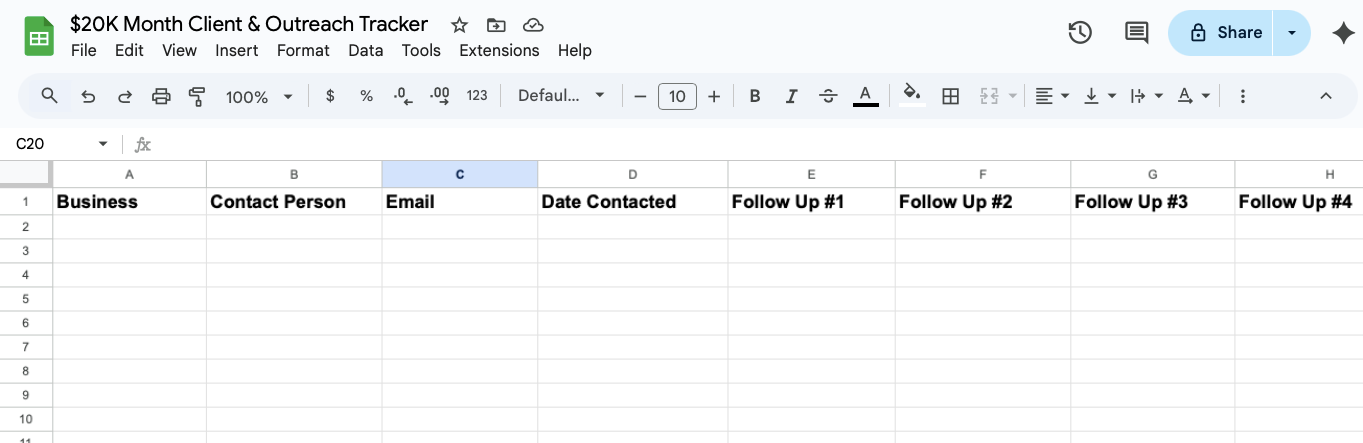
From there, you’ll come up with a list of 30 to 50 companies you want to target. ChatGPT can be a big help with this, but only if you use the right prompt. If you just ask for 30 healthcare companies, you probably won’t get the best responses. Here’s a prompt you can use:
Act as a B2B market research assistant. I am a [your niche] freelance writer who helps [type of companies] with [specific service]. Give me a list of 30 companies that:
Operate in the [industry]
Have between [X–Y employees] OR generate approximately [$X–$Y revenue]
Are actively producing content (blog, newsletter, resource center, etc.)
Would likely benefit from improving or scaling their content marketing
Prioritize companies that are growing or expanding into new markets. Include their website and a short sentence explaining why they would be a good prospect.
That alone should massively improve your results, but I wouldn’t stop there. Once it gives you a list, you’ll ask ChatGPT to refine it further with follow-up prompts. The exact prompt you use will depend on the kind of companies you’re looking for, but I might ask something like this:
“Now narrow this to companies that mention SEO, content marketing, or thought leadership in their job listings.”
3. Look for two contact people at each company
Now that you have your list of companies, you need to find two contact people at each company. I do this on LinkedIn using these steps:
Search for the company name
Click on the company’s LinkedIn page
Filter by “People”
Search for “Head of Editorial,” “Content Marketing Manager,” “Editorial Lead,” or some other variation
Look through the results and pick two contacts at that company
Honestly, you’ll have to play around with the title. My best recommendation is not to overthink this — my experience is that most people don’t really care that much if you email the wrong person. In fact, when that happens, the person I email will often pass my name on to the correct contact, so it all works out.
Finally, you may be wondering, why do I have to find two people to contact? I do this for a couple of reasons. First, I have had it happen where I’ll email someone, and the email immediately bounces back. Or I get an auto-responder saying that person is on maternity leave.
When that happens, I can immediately move on to the next person without wasting time looking for someone new. But another reason is that if the first person I contact doesn’t get back to me, I will wait several months and contact the second person.
4. Find their email addresses
Once you have the correct contact person, you need to find their email address. I recommend using Hunter.io — it offers a free plan with 50 email credits per month. I do usually end up paying more for credits, but I think it’s well worth it because it saves me so much time.
Once you’ve created an account, you’ll click “Finder” in the left toolbar and then “Find Email by Name.” Here’s an example of how to do this using my own name and website:
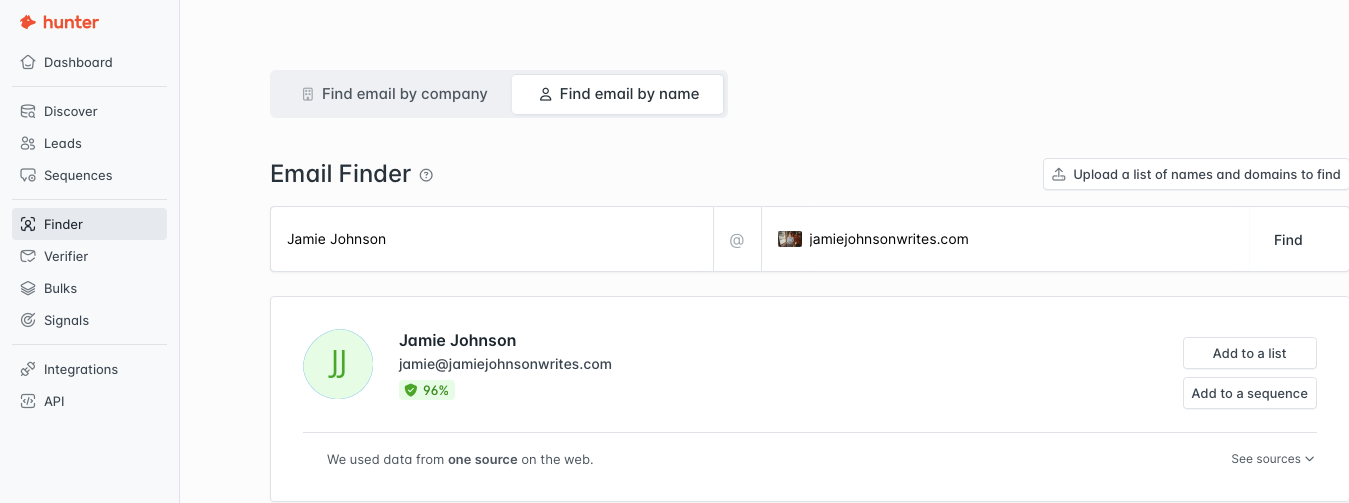
Note: This email address is correct.
5. Email three to five people a day
Okay, now that you have all the information you need, you’re going to start emailing three to five people a day. Why only three to five? When you really need to drum up new business, I know it can be tempting to try to email 10 or more people a day. But in my experience, it’s hard to stick with that kind of volume for very long.
The main thing you want to aim for is consistency. If you can consistently email three to five people a day over the next month, you’re likely going to start seeing results and having conversations with people.
How to write a good cold email
I debated whether or not to share an email template with you, but honestly, I think you need to come up with this yourself. Because, to put it plainly, my email template isn’t going to sound like you and likely won’t resonate with your ideal client. But here are some recommendations I have for coming up with a good email:
It’s okay to use a template: You don’t need to start from scratch every time — it’s okay to use a template that you change slightly for each new prospect.
Choose a very specific subject line: Your subject line should let the person you’re emailing know exactly what the email is about. Don’t try to keep cute or clever with the subject line. Honestly, that just annoys most people and they may mark your email as spam.
Keep it short: Obviously, you want your email to sound friendly, but don’t make the mistake of going on and on. People are busy, and if your email looks like a short novel, they will likely move on without reading it. I checked, and my cold emails are no more than two short paragraphs.
Include three samples: I never send my entire portfolio to a prospect. Instead, I send three very specific samples that are relevant to them. For me, this is where personalization comes in because I’m showing them why I’m a good fit to write for their company.
Include your LinkedIn profile: Personally, I don’t send prospects a link to my website and include my LinkedIn portfolio instead. LinkedIn is a better form of social proof than websites these days. Most clients really don’t care about digging through your services or reading your About page. When they click on my LinkedIn profile, they can immediately see that I’m a real person and I’ve written for dozens of companies in their industry.
Double-check it before you hit send: Proofread the email one last time before you hit send. I know that sounds obvious, but you will feel like an idiot if you realize later you misspelled someone’s name.
Final thoughts about cold emailing
I think cold emailing is one of the most effective ways to find new clients, but it is a long game. You simply can’t cold email a bunch of people and expect it to work overnight. Sometimes you get lucky, but in many cases, it can take a while to bring on a new client.
Even if people respond to you, there will likely be some back-and-forth. They may ask to schedule a call with you to make sure you’re legit. If the call goes well and they decide to work with you, you may need to go through onboarding and sign a contract. Once it’s all said and done, it could take several months before you’re assigned a single article.
I spent a lot of time cold emailing in the spring and summer of 2025. That probably resulted in about $12,000 in work for the year, which isn’t nothing. But I’ve really seen it pay off in the last couple of months. One client I cold emailed in September 2025 didn’t assign me any work until mid-December. But in the past two months alone, I’ve done roughly $10,500 worth of work for that client.
So my point is to stick with it and don’t get discouraged. If you can really commit yourself to cold emailing, you’ll be amazed by where your business will be in a year.